A practical guide for Australian gym owners, studio operators and fitness business owners planning a strength equipment purchase.
Strength training equipment forms the foundation of most gyms, strength facilities and training studios across Australia. From squat racks and barbells to selectorised machines and plate-loaded equipment, the right strength setup allows members to build muscle, improve performance and train safely under load, day after day.
But buying commercial strength equipment is a significant investment, and the decisions you make at the planning stage will shape member experience, operational costs and facility longevity for years to come. Get it right and you have a facility that members love, retains well and scales with your business. Get it wrong and you are left with equipment that breaks down, suits the wrong audience or wastes valuable floor space.
This guide is designed to help Australian gym owners, studio operators and fitness business owners understand what types of strength equipment are available, what to look for when comparing products, and how to approach purchasing decisions with confidence.
Types of Commercial Strength Equipment
Most strength training facilities include a mix of the following equipment categories. Understanding what each category offers (and who it serves), will help you build a balanced, functional strength zone.
To learn more about the other types of strength equipment that can help you make your gym floor the best it can be, check out the WNiF Buyer’s Guide to Functional Fitness Equipment.
Free Weights
Free weights are the cornerstone of any serious strength training environment. They allow members to perform compound, multi-joint movements that build functional strength, develop coordination and replicate real-world movement patterns.
A well-equipped free weights area typically includes:
- Barbells: Olympic barbells are the standard for commercial facilities, rated to 680 kg or more. Specialty bars such as hex bars, safety squat bars and EZ curl bars expand training options significantly.
- Weight plates: Bumper plates (rubber-coated) are preferred in functional training environments and Olympic lifting areas. Iron and cast steel plates suit traditional powerlifting and strength zones.
- Dumbbells: Rubber-coated hex dumbbells are the most durable and practical option for commercial use. A full set typically ranges from 2.5 kg to 50 kg or beyond, depending on your membership base.
- Adjustable benches: Flat, incline and decline capability in a sturdy, commercial-grade bench is essential for pressing movements. Look for benches with a high weight rating and non-slip upholstery.
Who free weights suit best
Free weights are non-negotiable for strength-focused gyms, functional training facilities, CrossFit-style boxes and any facility catering to experienced lifters. They also form a valuable secondary zone in general-purpose commercial gyms.
Racks and Power Cages
Racks are the centrepiece of most strength zones. They allow members to safely load and unload barbells for squats, bench presses, overhead presses, deadlifts and a wide range of accessory movements.
Common rack configurations include:
- Squat racks (also called half racks): A space-efficient option with two uprights and J-hooks. Suitable for smaller facilities or where floor space is at a premium.
- Power cages (full racks): Four-post cages with integrated safety bars provide the highest level of safety for solo lifting. The preferred choice for strength gyms and performance facilities.
- Half racks with pull-up stations: Combine squatting and pressing capability with an overhead rig element, making them versatile for mixed-use spaces.
- Multi-station rigs: Modular, multi-user systems allow several athletes to train simultaneously. Popular in functional training facilities and high-density commercial gyms. Can be configured to include pull-up stations, landmine attachments, cable columns and more.
Rack selection tip
For high-traffic commercial environments, prioritise racks with a minimum 11-gauge steel construction, commercial-rated J-hooks, and uprights rated to at least 450 kg. Cheap residential-grade racks will not withstand daily commercial use.
Plate-Loaded Machines
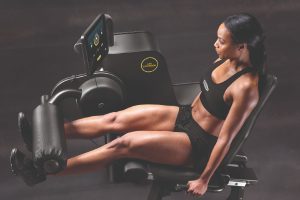
Plate-loaded machines replicate traditional barbell movements — such as leg press, hack squat and chest press — while providing greater stability and a fixed movement path. This makes them ideal for members who want to lift heavy without a spotter, and for intermediate lifters building strength on specific movement patterns.
Common plate-loaded machines include:
- Leg press machines: A staple of any lower body zone. Look for machines with a comfortable pad angle, smooth carriage action and a generous loading capacity (typically 500 kg+).
- Hack squat machines: A popular alternative or addition to the leg press that targets the quads through a different movement path.
- Chest press machines: Provide a guided pressing pattern for pushing strength development, suitable for a wide range of users.
- Seated row, lat pulldown and T-bar row machines: Expand upper body pulling capacity beyond what cable machines alone can offer.
- Hip thrust machines: Growing in popularity across Australian gyms, these target the glutes directly with heavy loading.
The main advantage of plate-loaded machines over selectorised equivalents is that they can handle significantly higher loads and tend to have a longer commercial lifespan. The trade-off is that members need to load and unload weight plates, which can create floor clutter if the facility is busy.
Selectorised Machines
Selectorised machines use a weight stack and a pin system, allowing users to select a resistance level quickly and easily. They are a practical, beginner-friendly option and form the backbone of general-purpose commercial gyms.
Common selectorised machine types include:
- Chest press and pec deck machines
- Lat pulldown and seated row machines
- Leg press, leg extension and leg curl machines
- Shoulder press and lateral raise machines
- Cable crossover columns (dual or single)
- Assisted chin-up and dip machines
Selectorised machines are particularly popular with beginner members who may feel intimidated by free weights, rehabilitation clients returning from injury, and older members seeking joint-friendly loading options. Because the weight is pre-set and the movement path is guided, the risk of technique errors or equipment misuse is lower.
From a business perspective, selectorised machines also reduce the supervision burden on gym floor staff, as members can use them with minimal instruction.
What to Consider When Buying Commercial Strength Equipment
Choosing the right commercial strength equipment goes well beyond comparing price tags. Below are the key considerations that should guide every purchase decision for Australian gym owners and facility operators.
1. Durability and Build Quality
Steel gauge and frame construction
The gauge of steel used in racks, frames and machine structures determines how well equipment handles heavy loads and regular impact. Lower gauge numbers indicate thicker steel. For commercial racks and cages, 11-gauge steel is the industry standard minimum. Budget options using 14-gauge or higher will flex, wobble or fail under sustained commercial use.
Weight ratings
Always check the stated weight rating of racks, benches and machines against the realistic maximum load your members will use. A rack rated to 250 kg may suffice for a yoga studio adding basic weights, but a strength gym serving competitive powerlifters needs equipment rated to 450 kg or more.
Finish and corrosion resistance
Australian commercial gyms — particularly those in coastal regions or that use chalk in the facility — need to consider how equipment holds up against humidity, sweat and abrasion. Powder-coated finishes are standard on quality commercial equipment and resist corrosion far better than bare or painted steel. Some premium brands also offer stainless steel hardware and chrome-plated components.
Upholstery and pad materials
Bench and machine pads take significant punishment. Commercial-grade vinyl upholstery with high-density foam is standard for a reason — it withstands repeated heavy use, resists tearing and is easy to wipe down. Avoid thin or soft foam padding, which compresses quickly and becomes a safety concern over time.
Key durability questions to ask suppliers
What gauge steel is used in the main frame?
What is the maximum rated load?
What is the warranty period on the frame versus the upholstery and cables?
How do replacement parts and cables get sourced in Australia?
2. Warranty and After-Sales Support
The warranty on commercial strength equipment is one of the most telling indicators of a product’s quality — and one of the most overlooked purchase considerations for gym owners.
A genuine commercial warranty will differentiate clearly between the frame, mechanical components, upholstery and cables — each of which has a different expected lifespan.
| Component | Typical Commercial Warranty |
|---|---|
| Frame / structural steel | Lifetime – 10+ years (leading brands) |
| Mechanical components | 3 – 5 years |
| Cables and pulleys | 1 – 3 years |
| Upholstery and padding | 1 – 2 years |
Beyond the written warranty, ask about the supplier’s service and support infrastructure in Australia. A product backed by a 10-year warranty is only as good as the supplier’s ability to provide replacement parts and technical assistance when something goes wrong. For Australian buyers, this means confirming that the supplier maintains local stock of consumable parts such as cables, guide rods, pulleys and pad materials.
3. Space Planning and Layout
Strength equipment requires more floor space than most gym owners initially estimate. A well-designed strength zone accounts not just for the footprint of each piece of equipment, but also the operational space required to use it safely.
Clearance and safety zones
As a general rule, each barbell station — whether a squat rack or a bench press — requires a minimum of 1.5 to 2 metres of clear space on each side of the bar end. This allows users to load and unload plates without obstructing other members or creating a trip hazard. Power cages and multi-station rigs require additional clearance around all four sides.
Traffic flow
The layout of your strength zone should allow members to move freely between equipment without crossing through active lifting areas. Consider the natural traffic flow from the entry point of the strength zone to the most popular pieces of equipment, and ensure pathways remain clear even during peak periods.
Flooring
Commercial rubber flooring with a minimum thickness of 15 mm is recommended under free weight areas, and 20 mm or more under Olympic lifting or heavy plate-loaded machine zones. The right flooring protects both equipment and the facility’s structural floor, reduces noise transmission and provides members with a safe, non-slip surface.
Zone design
Well-designed strength facilities typically separate or clearly delineate zones for:
- Olympic lifting and barbell work
- Powerlifting and heavy compound movements
- Functional training and multi-station rigs
- Machine-based strength training
- Dumbbell and bench work
Clearly defined zones reduce congestion, improve the member experience and help your team manage the space more effectively.
4. Member Demographics and Training Goals
The most important question to ask before purchasing any piece of strength equipment is: who is it for? Your member base — and the members you are trying to attract — should drive every equipment selection decision.
| Facility Type | Recommended Equipment Focus |
|---|---|
| General fitness gym | Selectorised machines, fixed dumbbells, basic racks, adjustable benches |
| Strength & powerlifting gym | Commercial power cages, competition barbells, bumper and iron plates, deadlift platforms |
| Functional training studio | Multi-station rigs, kettlebells, barbells, bumper plates, adjustable benches |
| Rehabilitation / allied health | Selectorised machines, light dumbbell range, cable columns, assisted movement equipment |
| High-performance / sports facility | Full rig systems, competition-spec barbells, specialty bars, plate-loaded machines, plyometric equipment |
| Boutique strength studio | High-quality racks, premium barbells and plates, select plate-loaded machines |
Your equipment mix signals to potential members what kind of facility you operate. A gym stocked with well-chosen, quality strength equipment attracts serious lifters, increases average member lifetime value and supports a premium pricing position.
5. Budget and Total Cost of Ownership
Commercial strength equipment pricing in Australia varies enormously, from entry-level products that may struggle to last three to five years of daily use, through to premium commercial-grade equipment with a lifespan of 15 or more years.
Purchase price versus total cost of ownership
Gym owners who focus exclusively on purchase price often find they spend more over time through higher maintenance costs, more frequent replacement, downtime during repairs and the hidden cost of member dissatisfaction caused by broken or degraded equipment. Evaluating the total cost of ownership — purchase price plus expected maintenance and likely replacement timeline — gives a more accurate picture of the real investment.
Staging your purchase
Most facility operators do not need to purchase every piece of equipment on day one. A staged approach — starting with the core pieces that serve the widest range of members and adding specialty equipment as membership grows — allows you to manage cash flow while maintaining a high-quality environment. Many commercial suppliers also offer equipment packages or staged delivery terms worth asking about.
Finance and leasing options
Equipment finance is widely available for commercial gym fitouts in Australia, with options ranging from hire purchase to chattel mortgage and equipment leasing. Some suppliers work directly with finance providers and can assist with pre-approval. Consulting with a finance broker familiar with the fitness industry is worthwhile for any significant purchase.
6. Safety Standards and Compliance
Commercial fitness equipment sold in Australia should comply with the relevant Australian and international safety standards. The primary standard applicable to strength equipment is EN 957, which covers stationary training equipment including strength training machines and racks.
When evaluating equipment, ask suppliers to confirm which standards their products are tested and certified to. Reputable commercial brands will be able to provide this documentation readily.
Beyond equipment certification, gym owners have a duty of care obligation under Australian Work Health and Safety (WHS) legislation to ensure that equipment in their facility is safe to use, maintained in good working order and appropriate for the members using it. This means:
- Conducting regular equipment inspections and logging maintenance activities
- Replacing worn components such as cables, pulleys and upholstery promptly
- Ensuring equipment is installed correctly, including correct anchoring of racks and rigs
- Providing appropriate instruction or signage for complex or high-risk equipment
Maintaining records of equipment service and any incidents
7. Choosing the Right Supplier
For commercial gym owners in Australia, the supplier relationship matters almost as much as the product itself. The right supplier provides more than equipment — they offer pre-sales advice, site planning assistance, delivery and installation, ongoing parts and service, and a genuine partnership as your business grows.
Questions to ask potential suppliers
- Do you have a showroom or demonstration facility in Australia?
- Can you provide references from comparable facilities you have supplied?
- Do you stock replacement parts locally, or are they shipped from overseas?
- What is your lead time for delivery and installation?
- Do you offer equipment packages or volume pricing?
- What training or onboarding support do you provide for new equipment?
- Can you assist with floor plan or layout design?
Suppliers who are reluctant to answer these questions clearly, or who cannot demonstrate a track record with commercial facilities of your type and scale, are worth approaching with caution regardless of how competitive their pricing appears.
8. Versatility and Future-Proofing
Buying strength equipment for a commercial facility is a long-term decision. The equipment you purchase today should still be serving your business — and your members — in 10 to 15 years. With that in mind, versatility and adaptability are valuable considerations.
Modular and expandable systems
Multi-station rigs and functional training systems that allow additional attachments, stations or accessories to be added over time provide strong long-term value. Rather than purchasing a fixed rig and then replacing it entirely when your needs evolve, a well-chosen modular system can grow with your facility.
Accessory compatibility
Racks and rigs that accept a wide range of third-party attachments — such as cable systems, landmine units, dip stations and monolift arms — give you flexibility to expand training options without replacing the core structure. Check whether your preferred rack brand’s accessories are available in Australia before committing.
Aesthetic longevity
Equipment aesthetics matter to members and influence perceived facility quality. Strength equipment in neutral colourways — black, grey, commercial silver — tends to age better and integrate more easily with future purchases than equipment in bold or trend-driven colour schemes.
Commercial Strength Equipment Planning Checklist
Before approaching suppliers, work through the following checklist to clarify your requirements and streamline the quoting process.
- Define your target member demographic and primary training goals
- Establish your total floor space available for the strength zone
- Confirm flooring type and condition (is new commercial rubber flooring required?)
- Identify whether structural anchoring of racks and rigs is feasible
- Set a realistic budget range including installation, flooring and accessories
- Determine whether a staged purchase approach is appropriate
- Research two to three reputable commercial equipment suppliers in Australia
- Request site visits or showroom demonstrations before committing
- Confirm warranty terms, parts availability and service support
- Check equipment compliance with relevant Australian safety standards
- Obtain at least two competitive quotes before making a final decision
To learn more about the other types of strength equipment that can help you make your gym floor the best it can be, check out the WNiF Buyer’s Guide to Functional Fitness Equipment.
Want to read more? Check out these articles:

2026 Buyers Guide: Commercial Functional Fitness Equipment in Australia
This guide has been created as a practical resource for gym owners, personal trainers, strength and conditioning coaches, studio managers, and anyone sourcing functional fitness equipment for commercial or semi-commercial use in Australia. Functional fitness training has moved from a niche offering to a mainstream expectation. Whether you’re opening a new facility, upgrading an existing

2026 Buyers Guide: Commercial Strength Equipment in Australia
A practical guide for Australian gym owners, studio operators and fitness business owners planning a strength equipment purchase. Strength training equipment forms the foundation of most gyms, strength facilities and training studios across Australia. From squat racks and barbells to selectorised machines and plate-loaded equipment, the right strength setup allows members to build muscle, improve

Take Advantage Of 2025 EOFY Sale On Commercial Gym & Fitness Equipment
With June 30 fast approaching, fitness business owners across Australia are preparing to wrap up the financial year, which means it’s the perfect time to upgrade your gym setup. There are numerous reputable suppliers with a sale on commercial gym and fitness equipment. Smart investments now could be fully tax-deductible, giving your business a financial

SMART TECH: The Les Mills Equipment That Hits Differently
For a long time, the equipment central to group fitness was very slow to innovate. As a world leader when it comes to group exercise programming, Les Mills has been in a unique position to develop cutting edge equipment that integrates seamlessly into group fitness classes, improving safety and delivering maximum results. It’s been a

The Underestimated Versatility of Sandbag Training
When we think of functional fitness and strength training, barbells, dumbbells, and high intensity cardio machines like the Technogym SkillMill might come to mind first. There are also some simple, yet highly effective tools that can be absolute powerhouses for functional fitness workouts such as BOSU, battle ropes and the humble, often overlooked sandbag. Sandbags

Five Questions With Panatta Australia’s Tony Griffin
WNiF had the opportunity to catch up with Tony Griffin, Managing Director at Panatta Australia at the AusFitness Industry Trade Show and Summit recently in Sydney. Panatta had an impressive range of their industry-leading commercial fitness equipment on display and was drawing plenty of attention from facility owners keen to level up their gym floor

Get More From Functional Training With Connexus By Matrix Fitness
Functional training has taken the fitness world by storm, and for good reason. Functional fitness moves away from aesthetics and focuses optimising our ability to perform real-life tasks, providing a far greater benefit over the long term than the reps of the past. Engaging multiple muscle groups at a time and not relying on specific

New Study Explores The Benefits of Eccentric Training for Athletes
A recent publication in the Scientific Journal of Sport and Performance highlights the transformative impact of digital weight on enhancing athletic performance. This could be because of the ability to utilise AI to train eccentrically, which is difficult to do without the help of another person. How is Emerging Tech Enhancing the Benefits of Eccentric

Nuforma Pilates: The Reformer Reinvented
Amid the technological upgrades of pretty much every other piece of exercise equipment, there’s been one item that has remained untouched – the Pilates reformer. Until now… Nuforma Pilates is the result of over 20 years of research and the previously UK-based offering is now available in the first Nuforma Pilates studio in Bondi Junction,