
Written by Mish Wright
When most people think of menopause, they picture hot flushes, night sweats, and maybe a few extra kilos around the middle. But what often gets left out of the conversation are the emotional and psychological shifts.
Anxiety, irritability, low confidence, and mood swings are also a direct result of hormonal changes combined with the social pressures women face in midlife. Trainers who only focus on the “physical” miss the opportunity to provide some of the most meaningful support: a space where women can practise calm, resilience, and strength in ways that go far beyond muscle fibres.
Menopause Mood Swings and Anger: What's Really Happening
Let’s talk about anger. Remember the teenage years — the yelling matches, the slammed doors, the muttered “I hate you” under our breath? Puberty was hormone chaos, and it often translated into rage.
Menopause can be just as volatile. Surging and declining hormones can trigger sudden bursts of anger that feel out of character — one minute calm, the next ready to tear someone’s head off. For many women, this rage is confusing and shame-inducing, but it’s also a very real symptom of the transition.
Here’s where training comes in. Movement provides a socially acceptable outlet for that energy, whether it’s pounding the battle ropes, lifting something heavy, or just walking it out with purpose. And on the flip side, regulating practices like breathwork and mobility help smooth the nervous system after the storm. Both outlets matter.
The Midlife Confidence Shift: Embracing Menopause as Liberation
This menopausal shift isn’t just physiological — it’s cultural. Melani Sanders’ We Do Not Care Club movement, which now has exploded to over 1.7 million Instagram followers, is proof. Her reels of midlife women listing what they’ve stopped caring about — from chin hair and leg hair, cancelling arrangements to cleaning the car — all strike a deep chord.
This is menopause as liberation. The anger, when channelled, becomes clarity. It strips away people-pleasing, and it demands environments (including fitness spaces) where women don’t have to shrink themselves.
For trainers, this means understanding that clients may arrive in sessions carrying not just stress, but also a sharpened intolerance for BS. Meeting that with respect, empathy, and flexible programming is how you keep women engaged — and how you ride alongside this cultural shift rather than resisting it.
How Social Stigma Affects Women's Confidence During Menopause
It’s not just biology. Women in midlife are navigating cultural stigma at the same time as hormonal change. Society often tells them:
- You’re no longer attractive.
- You’re less valuable at work.
- You’re meant to juggle teenagers, ageing parents, and career demands without complaint.
No wonder confidence takes a hit. Add to that the unhelpful noise in fitness culture: “Just lift heavy, stop complaining, and fix your body.” That kind of messaging doesn’t build empowerment — it fuels shame.
This is why menopause-informed training is feminist work. It’s about dismantling the stigma, naming the pressures, and offering a space where women don’t have to apologise for how they feel.
Why Cortisol and Oestrogen Matter for Menopause Training
Here’s a physiology reality check: cortisol and oestrogen don’t play nicely together. In midlife, oestrogen is already declining — the train is leaving the station. Add extra “carriages” of chronic stress and high cortisol, and you’ve just accelerated the depletion.
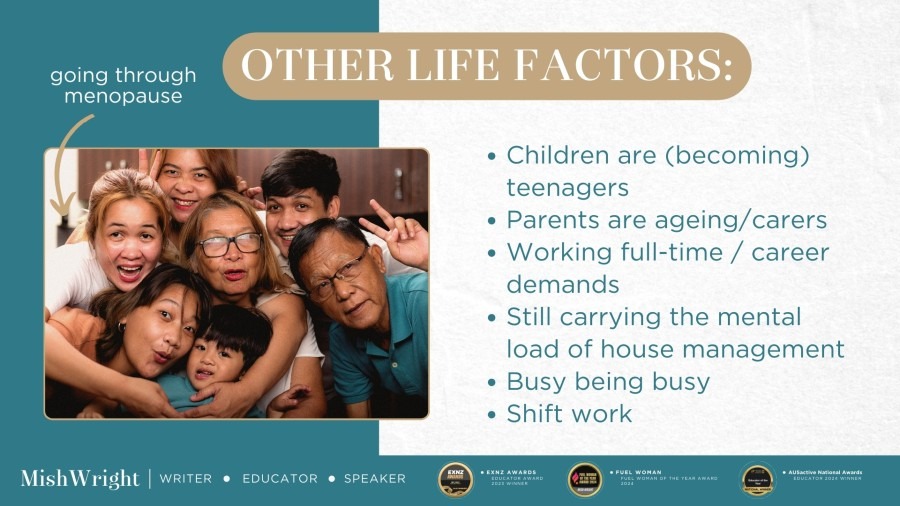
This matters for trainers, because many women are already living in high-stress environments:
- Caring for teenagers and ageing parents.
- Balancing demanding careers.
- Carrying the often-invisible mental load of house management.
- Often working longer hours or even shift work.
Our clients may not even realise their cortisol is elevated – this is simply their life and are just getting on with it. However, layering high-intensity training or a “go harder” mentality onto that stress doesn’t build resilience — it breaks it down.
The smarter play is to use exercise as a tool to reduce cortisol and create physiological calm.
How Exercise Stabilises Mood and Reduces Anxiety in Menopause
We know exercise boosts endorphins. But in menopause, it’s not just about a “runner’s high.” Regular, well-designed movement can:
- Stabilise mood swings.
- Reduce anxiety.
- Improve sleep quality.
- Give women a sense of control in a phase where so much feels unpredictable.
These are tangible, measurable outcomes that often matter more to women than shaving seconds off a 5k run or dropping body fat. Trainers who lean into this perspective position themselves as allies in mental health as much as physical health.
Using Exercise to Build Resilience and Mental Strength in Menopause
The gym, studio, or even the park session is more than just a place to sweat. For many midlife women, it’s the one protected hour of the day where they can practise stress resilience.
That might look like:
- Breath-focused cooldowns that reinforce relaxation cues.
- Strength sets framed not around aesthetics, but around competence: “Look how strong you are under pressure.”
- Mindset coaching built into sessions: reminding clients that progress isn’t always linear, but the act of showing up is itself resilience training.
This shift reframes exercise from punishment or body-correction into a rehearsal for confidence in daily life.
Why Community and Group Training Matter for Menopausal Women
Confidence isn’t built in isolation. Women thrive when they feel seen and understood, and group training environments can amplify that sense of belonging. Trainers who design inclusive group sessions — with options for intensity, cues for calm, and zero shame for symptoms — create communities where women feel stronger together.
Sometimes, the act of being in a room with others going through the same thing is more powerful than the programming itself.
Practical Menopause Training Strategies for Fitness Professionals
You don’t need a psychology degree to make a difference. Here are three practical things fitness professionals can start doing today:
- Cue Calm as Much as Effort – Balance “push yourself” with “notice your breath, release tension, let go.”
- Normalise Conversations – Bring menopause into the same everyday language you use for back health or shoulder safety.
- Respect the Rage – Recognise that anger and intolerance are part of this life stage. Don’t shame it, don’t dismiss it — offer healthy outlets.
Building Confidence Through Menopause-Informed Training: Key Takeaways
Confidence in menopause isn’t built by accident. It’s built through training environments that acknowledge the physiology of declining oestrogen, the impact of chronic stress, and the raw emotions of rage and release.
Trainers who get this right aren’t just helping women stay fit — they’re helping them stay calm, capable, and resilient in the middle of some of the most challenging years of their lives.
And that’s the point. Menopause-informed training isn’t just another niche trend. It’s a necessary evolution of fitness — one that builds women up instead of wearing them down.
Mish Wright (B.Ed, Dip Teach) is an award-winning writer, speaker, and educator recognised as one of the foremost leaders in women’s health and fitness. Named the 2024 Fuel Woman of the Year and Educator of the Year in both Australia (2021, 2024) and New Zealand (2023), Mish has challenged the industry to address the gender gap in fitness education. She is Head of Education at Women’s Fitness Education (WFE), where she delivers women’s health–focused training as part of Certificates III and IV in Fitness. Her four courses, sold in five countries and completed by thousands of professionals, continue to reshape how fitness is taught and practised.
Mish is the creator of the Menopause Training Matrix™, a system that helps trainers translate research into symptom-led, client-centred programming, and the GRACE Protocol™, a simple yet powerful framework for midlife women’s training built around Grit, Regulate, Accumulate, Cardio, and Endurance. Through her writing and speaking, she pushes the industry toward systemic change, making women’s health education both accessible and practical for fitness professionals worldwide.
Check out these articles:

Should You Be Recommending Acupressure Mats to Clients?
If you’ve been training clients for more than a few months, you’ve had the conversation: someone mentions they’ve started using a “spike mat” for their back, or they saw one on a mate’s Instagram story, and they want to know if it’s worth trying, or whether you’d recommend one yourself. Acupressure mats (also called spike

Snack Smart on the Snow: Why Pistachios Are a Winner for Active Clients
The Aussie ski season is underway across the Snowy Mountains, Falls Creek, and Mt Buller. If your clients are heading to the slopes, there’s a good chance their nutrition plan goes out the window the moment they hit the mountain. As a fitness professional, this is actually a great opportunity to have a simple, practical
Building Confidence and Calm Through Menopause-Informed Training
Written by Mish Wright When most people think of menopause, they picture hot flushes, night sweats, and maybe a few extra kilos around the middle. But what often gets left out of the conversation are the emotional and psychological shifts. Anxiety, irritability, low confidence, and mood swings are also a direct result of hormonal changes
Why HYROX Training Is Reshaping the Australian Fitness Industry
More than 1.5 million people globally now compete in HYROX annually. In Australia, the race-style fitness format has moved well past early adopter status and into the mainstream, and the business of fitness is starting to reflect that shift in a serious way. Virgin Active Australia’s recently launched HYROX partnership gives the industry one of
How Smart Gym Owners Are Turning the HYROX Boom Into a Retention Engine
The Les Mills x HYROX partnership isn’t just big news for the fitness industry. For gym owners and fitness professionals across Australia, it’s a ready-made solution to one of the hardest problems in the business: keeping members engaged long enough to stay. Walk the floor of almost any commercial gym in Australia right now and

Fitesque: The New Dance Fitness Licensing Opportunity for Australian Studios
Walk into almost any fitness studio in Australia right now and you’ll find a familiar lineup: HIIT, reformer Pilates, yoga, and cycle. All solid. All proven. And all increasingly indistinguishable from the studio down the road. For studio owners and independent instructors, the challenge isn’t attracting fitness enthusiasts – it’s attracting people who have quietly

Mid-Life Women as PT Clients: Exercise for Hot Flushes and Sleep Problems
Article by Mish Wright. If you believe the current fitness headlines, there’s only one prescription for midlife women: lift heavy and lift often. Strength training is vital — no argument there — but the problem is the way it’s become the only message. Cardio is being quietly cancelled, as if running, cycling, swimming, or even

Personal Training Clients on Weight Loss Medication
As more Australians embark on medical weight loss treatments, many trainers now find themselves training clients on weight loss medication without fully understanding what these drugs do, how they affect exercise performance, or what’s within their professional scope. Clients may casually mention, “I’ve just started Ozempic,” leaving trainers torn between curiosity, concern and confusion. In

Training Clients with TFCC Injury: A Practical Guide for Fitness Professionals
You’ve worked hard programming an intense session for your client, only to have them walk into the gym clutching a crumpled radiology report and saying, “My physio says it’s a TFCC tear.” It’s normal for trainers to freeze at a point somewhere between concern, confusion, and “Wait… what complex?” before realising that all your programming
