
Most fitness franchises spend their first few years finding their footing. J.I.M (Joy in Movement) spent its first three years selling out. Since opening its debut studio in Glenhaven, Sydney in July 2023, the infrared-powered, 30-minute workout brand has sold more than 80 territories across New South Wales, Queensland, Victoria and the ACT. There are 35 studios currently operating, with over 50 expected to be trading by July 2026.
For fitness business owners watching the franchise market, that pace of growth raises an obvious question: what is actually pulling buyers toward this model, and does it hold up once the studios are open and running?
How J.I.M's Franchise Model Turns Automation Into a Simpler Business
Founder and CEO Jarad Hobbs isn’t new to fitness ownership. Before launching J.I.M, he spent more than 20 years as an owner-operator in the industry, and that background shapes how he talks about what the brand is trying to solve.
“I think a big part of the demand is that people are looking for business models that make sense for the world we’re moving into,” Hobbs says. “Technology and AI are changing almost every industry, and we’ve built J.I.M around the idea that technology should make a business simpler to operate, not more complicated.”
That thinking shows up most clearly in the studio format itself. Each J.I.M session is delivered through a structured, screen-guided system that combines infrared heat with low-impact functional movement, and the workout runs without a live instructor calling the class. For an industry where coaching wages are usually one of the biggest line items on a profit and loss statement, that is a significant structural shift.
Hobbs is careful about how he frames it, though. “We don’t really think of J.I.M as being without a coach. J.I.M is the coach,” he says. “The technology guides and instructs you through the entire workout, but without some of the things that can make traditional fitness intimidating, such as feeling watched, judged, compared to someone else or pushed beyond where you’re comfortable.”
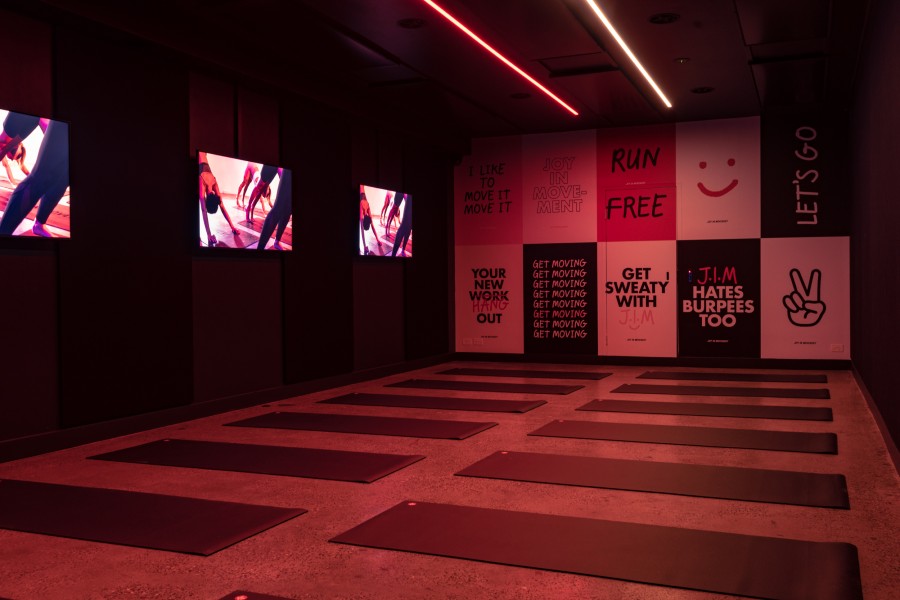
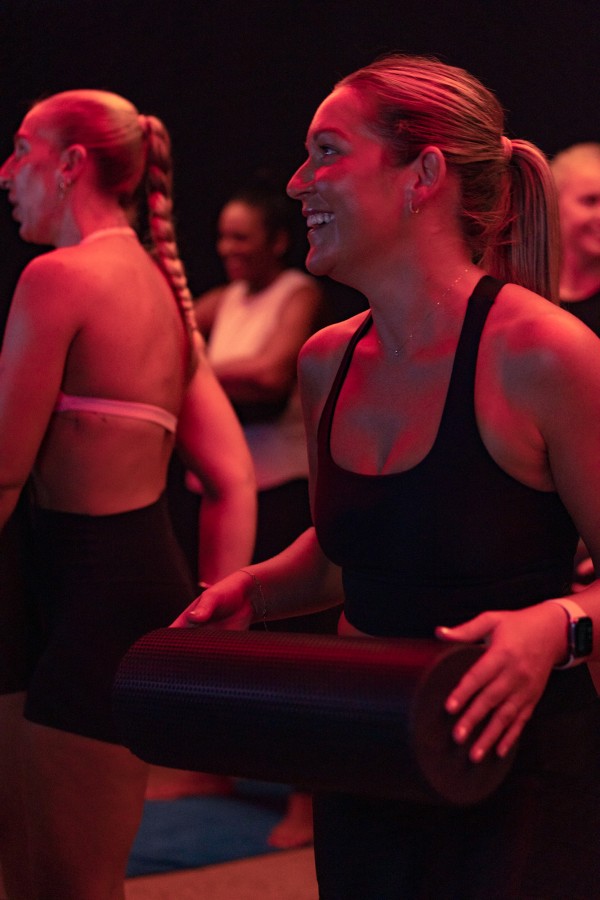
That distinction matters for two different audiences at once. For members, it is the pitch behind the brand’s dark, mirror-free studios, an environment designed to let people move without the self-consciousness that keeps a lot of would-be exercisers out of group classes altogether. For franchise buyers, it is the economic case: a leaner staffing model, a smaller footprint, and a business that can typically run with a single on-site team member.
Why J.I.M's Lean Staffing Model Still Needs a Hands-On Franchise Owner
It would be easy to assume that automating the workout means automating the business, but Hobbs pushes back on that idea. “The workout experience itself is automated, but the business isn’t,” he says. “You still need someone driving the business, building the local community and creating a great member experience.”
That is a distinction worth sitting with for anyone evaluating a franchise investment in this space. Removing a coaching roster from the cost base doesn’t remove the work of running a studio, it relocates it. Hobbs describes the shift plainly: “Staffing is traditionally one of the biggest costs and operational complexities in fitness. By automating the delivery of the workout, we’ve been able to build a much leaner operating model and improve the economics for the owner. What scaling has reinforced for us is that automation doesn’t remove people from the business, it changes where they’re most valuable. Instead of paying someone primarily to deliver the workout, the owner and team can focus their energy on members, community, sales and growing the studio.”
That last point lines up with who Hobbs says the model suits best. “Our strongest fit tends to be an engaged owner-operator or an owner who has a strong manager running the studio day to day,” he says. It’s a reminder that a lean operating model still rewards hands-on ownership. The studios that are likely to perform well are the ones where someone is actively building local relationships and driving membership, not simply collecting a management fee from an automated system.
Targeting The Next Australian Growth Markets
With studios already trading across metropolitan, suburban and regional pockets of NSW, Queensland, Victoria and the ACT, Hobbs says the pattern emerging is less about demographics and more about proximity. “Convenience is probably more important than any one demographic or postcode,” he says. “Our studios are deliberately small and designed to be close to where people live. The idea is that getting a workout shouldn’t require a major trip or become another difficult thing to fit into someone’s day.”
That thinking is pointing the brand toward markets that traditional gym operators have often overlooked. “Regional and outer-suburban Australia is particularly interesting because in many of those communities there simply isn’t the same breadth of fitness options you see in major metropolitan areas,” Hobbs says. “A smaller-format model like ours can make sense in markets where a traditional large-format gym might not.”
It’s also a signal that the brand’s Australian growth story is far from finished. “We’re still relatively early in Australia,” Hobbs notes. “Most of our growth so far has been concentrated across New South Wales, Queensland and Victoria, with expansion into the ACT, so there are entire states and significant parts of the country we haven’t entered yet.”
What J.I.M's Growth Means for Fitness Franchise Owners in Australia
J.I.M’s growth curve offers a useful case study for anyone weighing up a franchise model in the current fitness landscape. The brand has shown that a low-staffing, technology-led format can scale quickly and attract buyers well beyond the major metro corridors, but Hobbs’ answers also make clear that the model isn’t a passive investment. It rewards owners who treat the studio as a community to be built, not a system to be switched on.
As Hobbs puts it, the ceiling isn’t really about a target number of studios. “We don’t think about the ceiling purely in terms of how many studios Australia can hold,” he says. “We think about how many communities could support a convenient, close-to-home J.I.M, and we believe there’s still a very significant runway ahead of us.” For an Australian fitness franchise still working through its home market, that runway looks like the more interesting story than any single expansion headline.
Check out these articles:

8 Fitness Franchises That Could Come To Australia
Franchising continues to drive the growth of the health and wellness industry, and the concepts chasing Asia-Pacific expansion in 2026 look nothing like the boutique studios of a decade ago. With more than 30 established fitness franchises already competing for space in Australia, we went looking for something different: brands that are either talking openly
BFT PODIUM Series: The Event Model Driving Franchisee Revenue and Member Retention
Body Fit Training (BFT) held the global launch of its PODIUM Series last weekend, on Sunday 2 August 2026, across 300+ studios in 10+ countries. The in-studio event series is designed to open up new revenue and improve member retention for franchise owners, with more than half of that global footprint based in Australia. To

Wildsoul Wellness Is Growing Fast and Its New Precision Health Program Is the Reason Franchisees Are Taking Notice
What prospective franchisees need to know about Australia’s fastest-growing wellness brand and its game-changing new offering. The Australian wellness industry is crowded, competitive, and full of franchises making nearly identical promises. Community. Movement. Recovery. Belonging. The language is familiar because almost everyone uses it. So when a franchise finds a genuine point of difference, one

From One Studio to Nearly 60 Locations: Inside One of Australia’s Fastest-Growing Boutique Fitness Franchises
Walk into any inLIFE Wellness studio and you’ll notice something a little unusual. The instructor leading the class might also be the owner. The member in the back row might be opening her own location next month. The whole place hums with a kind of buy-in you don’t usually see in boutique fitness — and

How Jetts Fitness Is Rewriting the Rules of Australian Gyms
Australia’s original 24/7 no-lock-in contract gym brand is expanding fast – and the numbers tell the story. With six new clubs set to open in quick succession and a landmark flagship just launched on the Sunshine Coast, Jetts Fitness Australia is positioning itself as the benchmark for accessible, flexible fitness in a market increasingly defined

Opening a Gym in Australia: Is the Market Saturated in 2026?
The Australian fitness landscape has transformed dramatically over the past decade. Between 2015 and 2024, the number of gyms and fitness centres across the country expanded at an unprecedented rate, driven by boutique studios, 24-hour franchises, and increasingly health-conscious consumers. Now, as we move through 2026, aspiring fitness entrepreneurs face a critical question: has the

The Plus Fitness Playbook To Successful Scaling
The opening of Plus Fitness Mambourin last month marked a milestone for the brand, which has seen its trajectory turbo-charge since its 2020 acquisition by ASX-listed company Viva Leisure. Mambourin marks 200 clubs opened with around 200,000 members and more sites in the pipeline across Victoria and New South Wales. For Australian gym owners, a

An Insider’s Guide To Raising A Family While Growing A Business
Balancing the demands of parenthood with the responsibilities of running a business is no small feat. For Georgie Richard and her husband Mitch, owners of Fitstop Wollongong, it’s a daily juggle between managing their thriving gym and raising their young family. We took a peek beneath the superhero cape and asked Georgie how she and

Driving Growth in Australian Fitness Franchises By Leveraging Technology and KPIs
This article was provided by Jaffrey Ali, Chief Product Officer at FranConnect As Summer approaches, gyms across Australia are experiencing a surge in memberships. Health-conscious individuals, both new and returning, are flocking to fitness centres to prepare for the warmer months. This rising trend presents a golden opportunity for fitness franchises and multi-location gyms to