
Legal Steps to Prepare Your PT Business for the New Year

The end of the year brings more than just Christmas parties and beach holidays for Australian personal trainers. It’s the perfect opportunity to ensure your legal house is in order before the new year begins. While most PTs are brilliant at designing programs and motivating clients, the legal side of running a personal training business often gets pushed to the bottom of the priority list until something goes wrong.

The reality is that Australia’s regulatory environment for personal trainers has become increasingly complex. From workplace health and safety obligations to insurance requirements and evolving privacy laws, staying compliant isn’t just about avoiding fines. It’s about protecting the business you’ve worked so hard to build and ensuring you can focus on what you do best: helping people achieve their fitness goals.

With the Australian personal training market valued at $433.1 million in 2024 and over 6,000 personal training businesses operating across the country, the industry is both thriving and competitive. Getting your legal foundations right can be the difference between sustainable growth and costly problems down the track.

Understanding Your Business Structure and Certification Requirements as a Personal Trainer

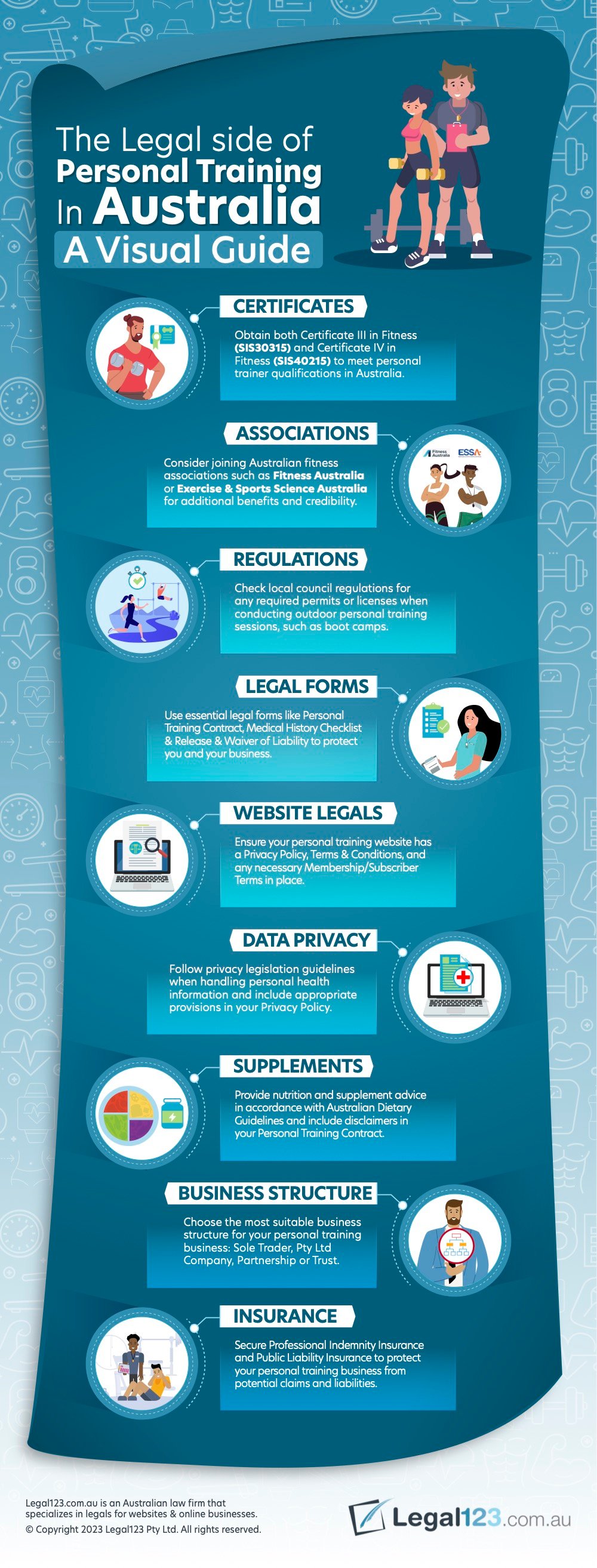
Before diving into specific compliance areas, it’s worth reviewing whether your current business structure still serves you well. Many personal trainers start as sole traders, but as your business grows, this structure can expose you to unnecessary personal liability. If you’re expanding your client base, running bootcamps, or bringing on other trainers, having a conversation with a business lawyer or accountant about whether a company structure might offer better protection is time well spent.

Your business structure determines everything from your tax obligations to your personal liability if something goes wrong. A sole trader working one-on-one with clients has very different legal requirements compared to someone running group sessions with multiple locations. The new year is an ideal time to ensure your structure still matches your business reality, not what it was when you first registered your ABN.

It’s also crucial to verify that your certifications are current. In Australia, personal trainers must hold a Certificate IV in Fitness (SIS40221) to work with individual clients. If you’re running bootcamps or group training, you need to ensure your qualifications cover group instruction. Beyond the basic certification, keeping your first aid and CPR certificates up to date isn’t just good practice, it’s often required by your insurance policy and any industry association memberships you hold.

personal training business legal set up

PT Insurance: Have You Got the Right Cover?

Insurance is one of those areas where personal trainers often think they’re covered until they actually need to make a claim. Professional indemnity and public liability insurance are non-negotiable in the Australian fitness industry, but the level of coverage you had when you started might not reflect your current operations.

Have you added new services this year? Started running outdoor bootcamps? Begun offering nutritional guidance? Each of these changes can affect your insurance requirements. The Australian fitness industry has seen several cases where trainers believed they were covered, only to discover their policy excluded specific activities or had coverage limits that were too low.

Before the new year, schedule a proper review with your insurance broker. Don’t just renew automatically. Go through your policy document and make sure it covers everything you’re actually doing. If you’re running beach sessions, check whether outdoor activities are included. If you’ve started online coaching, verify that your professional indemnity extends to digital services. The cost difference between adequate coverage and inadequate coverage is minimal compared to the potential consequences of getting it wrong.

Professional indemnity insurance covers you if a client claims that the professional advice or services you provided were negligent and caused them injury or loss. Public liability insurance covers you if a third party suffers personal injury or property damage from the operation of your personal training business. Both are essential, but they cover different scenarios, which is why most trainers need both policies.

Workplace Health and Safety Compliance as a PT in Australia

Work health and safety requirements vary across Australian states and territories, but the fundamental principle remains the same: you have a legal duty to provide a safe environment for both clients and any staff or contractors you engage. This extends beyond just maintaining equipment and keeping training areas clear.

Your workplace health and safety obligations include having proper risk assessments, emergency procedures, and incident reporting systems in place. If you’re bringing on other trainers to help with your growing client base, you’re responsible for their safety too. This means ensuring they’re properly qualified, inducted into your safety procedures, and aware of emergency protocols.

The new year is an excellent time to conduct a thorough safety audit of your operations. Walk through your training locations with fresh eyes. Are your emergency procedures documented and accessible? When did you last check your first aid kit? Do you know the quickest route to the nearest hospital from each location you use? These aren’t just theoretical questions. Every personal trainer should be prepared for the reality that medical emergencies can and do happen.

For outdoor and mobile trainers, safety planning requires extra attention. You need documented risk assessments for each location you use, including considerations like weather conditions, surface quality, proximity to emergency services, and potential hazards specific to that environment. Local councils are becoming more vigilant about commercial fitness activities in public spaces, so ensuring you have the proper permits and insurance is increasingly important.

How Does Privacy and Data Protection Impact Personal Trainers?

Australia’s Privacy Act has significant implications for personal trainers, particularly with the introduction of stronger enforcement measures in recent years. If you collect any personal information from clients, including basic contact details, health screening questionnaires, progress photos, or body measurements, you’re handling personal information that’s protected by law.

Health and medical information are among the most sensitive types of personal data. When you ask clients to complete a medical history checklist or record their injuries and health conditions, you’re taking on specific legal obligations about how that information is collected, stored, used, and eventually destroyed.

Start by reviewing what information you actually collect and why you need it. Many personal trainers have accumulated client data over years without really considering whether they still need all of it or how they’re protecting it. Your privacy policy should be more than just something you copied from another website. It needs to accurately reflect how you collect, use, store, and protect client information.

Consider how you’re storing client data. Are health questionnaires sitting in an unlocked filing cabinet? Are client records on an unprotected laptop or in an unsecured cloud storage account? What happens to client information when someone cancels their sessions? Having clear data retention and deletion policies isn’t just good practice, it’s increasingly expected by privacy regulators and your clients.

A proper privacy policy should outline what information you collect, why you collect it, how you store and protect it, when you might need to disclose it, and how long you keep it. It should also explain how clients can access their information or request corrections. This doesn’t need to be a 50-page legal document, but it does need to be honest, clear, and actually followed in your business operations.

Contractor vs Employee Relationships in the Fitness Industry

The line between employee and contractor has become one of the most contentious legal issues in the Australian fitness industry. The Fair Work Ombudsman has been actively investigating fitness businesses, and the penalties for misclassifying employees as contractors are substantial, including back payment of superannuation and entitlements.

According to Freedom of Information data, the Fair Work Ombudsman was contacted by fitness industry workers 6,267 times over a five-year period, highlighting just how common workplace disputes are in this sector.

If you’re thinking about bringing on other trainers to help with your growing business, take an honest look at how those relationships would be structured. Do you control when and where they work? Do they wear your branded clothing? Do they use your equipment and work exclusively for your business? Do you set their rates and take a percentage? These factors all point toward an employment relationship, regardless of what your written agreement says or whether they have an ABN.

The new year is the right time to get proper legal advice on your working arrangements before you expand. If trainers are genuinely independent contractors, they should have their own ABN, their own insurance, control over their rates, the freedom to work for other businesses, and the ability to send someone else to cover a session if they’re unavailable. If that doesn’t describe your arrangement, you may need to structure things differently to comply with Australian employment law.

The stakes are high here. If you’re found to have misclassified employees as contractors, you could face back payment of superannuation, annual leave, sick leave, and other entitlements, plus penalties. Getting this right from the start is far easier than trying to fix it later.

PT Client Contracts and Liability Waivers

Most personal trainers have some form of agreement that clients sign when they start training, but many of these documents are either outdated, copied from overseas sources, or so generic they provide little real protection. Your client contracts need to be specifically drafted for Australian law and your particular business operations.

At minimum, your personal training contract should clearly address payment terms, cancellation policies, what happens with missed sessions, liability limitations, and how disputes are resolved. It should also reflect any specific aspects of your business, whether that’s outdoor training, online coaching, or specialized programs like pre and postnatal training.

A medical history checklist is essential for every client, not just to design appropriate programs but to protect yourself legally. This checklist should identify people who may have medical conditions that put them at higher risk of injury during physical activity. Always use a comprehensive checklist to decide whether the potential benefits of exercise outweigh the risks for a particular individual. Remember that this medical information is highly confidential and needs to be protected under privacy laws.

Having clients sign a liability waiver doesn’t give you unlimited protection from liability claims, but it does help establish that clients understand the inherent risks of physical activity. Your waiver should be clear, specific, and regularly updated to reflect changes in your services or relevant case law. This is one area where professional legal advice is worth the investment rather than relying on generic templates that might not hold up if challenged.

If you’re offering nutritional guidance as part of your service, your contracts need to address this carefully. Personal trainers can provide basic healthy eating information that follows the Australian Dietary Guidelines, but you need to be clear about the scope of your advice and include appropriate disclaimers. Make sure your medical history checklist covers allergies and dietary restrictions, and include a disclaimer that covers any nutrition or supplement advice in your client contracts.

A Personal Training Legal Package

Affiliate Disclosure: This article contains affiliate links to Legal123 products. If you purchase through these links, What’s New in Fitness may receive a commission at no additional cost to you. We only recommend products and services we believe will provide value to Australian personal trainers.

Getting all these legal documents right can feel overwhelming, especially when you’re busy running sessions and growing your business. That’s where having professionally drafted, Australian-specific legal documents makes a real difference.

The Personal Training Legal Package from Legal123 provides everything you need to set up your personal training business properly from a legal standpoint. The package includes a comprehensive Personal Training Contract, Release and Waiver of Liability, Medical History Checklist, and Website Legals, all specifically designed for Australian personal trainers.

What makes this package particularly valuable is that it’s customisable to your specific business. You’re not getting a one-size-fits-all template that might not match what you actually do. The documents are drafted by experienced Australian lawyers who understand the fitness industry and can be tailored to cover outdoor training, online coaching, nutritional guidance, or whatever services you offer.

The package is designed to be user-friendly. You answer a few simple questions about your business, and the system generates documents that match your specific situation. Everything is provided in plain English with clear instructions, so you don’t need a law degree to understand what you’re signing clients up for. Plus, you get email and telephone support if you have questions.

At $379 plus GST, it’s a one-time investment that you can use again and again with new clients. Compare that to the cost of having a lawyer draft custom documents from scratch, which would easily run into thousands of dollars. More importantly, compare it to the potential cost of not having proper legal protection in place when something goes wrong.

Many personal trainers put off getting proper legal documents because they assume it will be expensive or complicated. The reality is that having these foundations in place from the start is far easier and cheaper than trying to fix problems after they occur. When you’re confident that your contracts are solid, your waivers are enforceable, and your client information is properly protected, you can focus your energy on what you do best.


personal trainer legal requirements
Source: Legal Guide for Personal Trainers from Legal123.com.au

Preparing your personal training business legally for the new year isn’t about creating barriers or bureaucracy. It’s about building a sustainable foundation that lets you grow with confidence. When you know your insurance is appropriate, your client contracts are solid, your working arrangements are compliant, and your client data is properly protected, you can focus your energy on delivering excellent service rather than worrying about potential legal problems.

The personal training industry in Australia is thriving. With 62% of Australians now combining online and in-person training, according to AUSactive’s last survey, there are more opportunities than ever for personal trainers who can adapt to client needs and deliver flexible, professional service.

As the industry grows and professionalises, the legal and regulatory environment will continue to evolve. Personal trainers who take their legal obligations seriously, maintain proper documentation, and protect both themselves and their clients are the ones who build sustainable, successful businesses that can weather challenges and capitalise on opportunities.

By making legal compliance a regular part of your business rhythm rather than an emergency response to problems, you’re positioning your personal training business for long-term success in an increasingly competitive and regulated market. The new year is the perfect time to get it right.

Disclaimer: The information provided in this article is general in nature and intended for educational purposes only. It does not constitute legal, financial, or professional advice and should not be relied upon as such. Every personal training business has unique circumstances, and legal requirements may vary based on your specific situation, location, and business structure. We strongly recommend that you seek individualised advice from qualified legal and accounting professionals who can assess your particular circumstances before making any decisions about your business operations. While we strive to ensure the accuracy of the information presented, laws and regulations change regularly, and we make no warranties about the completeness, reliability, or suitability of this content for your specific needs.

Working as a fitness professional in Australia?

Check out these articles:

ultra crossfit brisbane gym owners

Opening a Gym in Australia: Is the Market Saturated in 2026?

The Australian fitness landscape has transformed dramatically over the past decade. Between 2015 and 2024, the number of gyms and fitness centres across the country expanded at an unprecedented rate, driven by boutique studios, 24-hour franchises, and increasingly health-conscious consumers. Now, as we move through 2026, aspiring fitness entrepreneurs face a critical question: has the

Read More »
selling tips to make your fitness business boom in 2026

6 Selling Tips To Make Your Fitness Business Boom in 2026

The Australian fitness industry is experiencing a profound transformation. After weathering pandemic closures, navigating the hybrid training revolution, and watching consumer behaviour shift dramatically, fitness professionals across Sydney, Melbourne, Brisbane, and beyond are entering 2026 with a critical question: how do we not just survive, but genuinely thrive? The businesses that will boom in 2026

Read More »
working with pt clients weight loss medication

Personal Training Clients on Weight Loss Medication

As more Australians embark on medical weight loss treatments, many trainers now find themselves training clients on weight loss medication without fully understanding what these drugs do, how they affect exercise performance, or what’s within their professional scope. Clients may casually mention, “I’ve just started Ozempic,” leaving trainers torn between curiosity, concern and confusion. In

Read More »
plus fitness successful franchise

The Plus Fitness Playbook To Successful Scaling

The opening of Plus Fitness Mambourin last month marked a milestone for the brand, which has seen its trajectory turbo-charge since its 2020 acquisition by ASX-listed company Viva Leisure. Mambourin marks 200 clubs opened with around 200,000 members and more sites in the pipeline across Victoria and New South Wales. For Australian gym owners, a

Read More »
eofy tax time fitness business

Take Advantage Of 2025 EOFY Sale On Commercial Gym & Fitness Equipment

With June 30 fast approaching, fitness business owners across Australia are preparing to wrap up the financial year, which means it’s the perfect time to upgrade your gym setup. There are numerous reputable suppliers with a sale on commercial gym and fitness equipment. Smart investments now could be fully tax-deductible, giving your business a financial

Read More »
install sled track for gym

3 Fitness Products You Should Have In Your Gym in 2025

The Aussie thirst for gym facilities is as strong as ever and the greatest challenge for fitness business owners is retaining members in a highly competitive market. There are some pieces of equipment that you could expect to find in pretty much any fitness centre, such as weight plates, dumbbells and cardio machines, but what

Read More »
jetts fitness ausactive awards winners 2024

Australian Fitness Industry Awards Open Nominations For 2025

The AUSactive National Awards celebrate the incredible work being done across the active health and exercise industry in Australia. Formerly known as the Fitness Australia Awards, they shine a spotlight on both individuals and organisations making a real difference – those leading the way, inspiring, and helping create healthier, more active communities. These prestigious Australian

Read More »
Scroll to Top