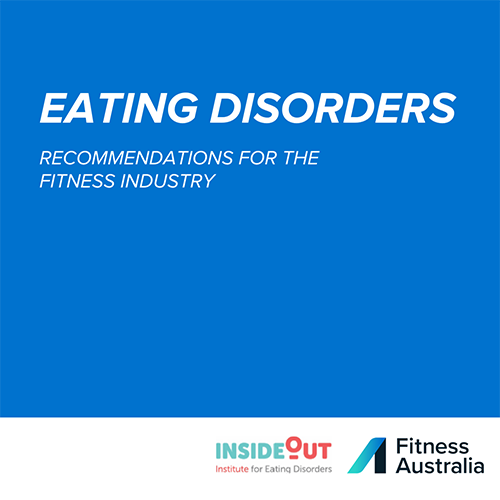

InsideOut Institute for Eating Disorders and peak industry association Ausactive have launched recommendations for the identification and support of those living with eating disorders in the fitness industry in Australia.
Eating disorders have low detection and intervention rates, gyms and fitness clubs are at-risk settings for the presentation of eating and exercise disorders, and as such present an opportunity to increase identification.
Recommendations for the fitness industry around eating disorders
Eating Disorders: Recommendations for the Fitness Industry has been developed to help fitness businesses and exercise professionals work effectively with people who have an eating disorder, exercise disorder or muscle dysmorphia.
The recommendations have been written and reviewed by a team of experienced mental health, medical and fitness professionals, as well as researchers and policy experts.
“Gyms and fitness facilities are one of the most important commercial settings for the identification of eating disorders and early intervention,” says Dr Sarah Maguire, Director of InsideOut Institute, a collaboration between University of Sydney’s Charles Perkins Centre and Sydney Local Health District.
“Eating disorders frequently present within the fitness industry, have a high prevalence among sports people, and have high mortality rates, posing a significant issue for professionals who are not necessarily trained in the management of this illness group,” says Dr Maguire.
How can the fitness industry help people with disordered eating?
“Fitness professionals do not receive routine training in mental health first aid and need to be equipped with the skills to address these high prevalence disorders in their work settings.”
“People working in the fitness industry are really on the frontline when it comes to eating disorders. We are hopeful this set of recommendations can promote the early identification of eating disorders, and sensitive and appropriate handling of people who present with symptoms.” says Dr Maguire.
Ausactive CEO Barrie Elvish says personal trainers, fitness instructors and fitness businesses managers have an important role to play when it comes to eating and exercise disorders.
“We want our Registered exercise professionals to have access to the best available training, including training on how to be part of the solution for people with eating disorders.”
“We always want them to be working within their scope of practice including knowing when and where to refer a client for medical review. Exercise professionals can also play a vital role in recovery, by working collaboratively with a treatment team.”
“Exercise professionals and fitness businesses can help reduce risk by having a positive approach to promoting physical activity and health – instead of one that focuses on guilt and shame around weight and shape.”
“We’d love to see these practical recommendations used in all fitness settings across Australia as an industry standard.”
The importance of early detection of eating disorders
Australian cricketer Sarah Coyte is a personal trainer with a lived experience of an eating disorder. Coyte has played in three Ashes series and four World Cups and ranks among the best female bowlers in the world.
“I have struggled with an eating disorder since I was a teenager. It has stolen years of my life even when I was competing on the world stage.”
The eating disorder continued to worsen until Coyte had to step away from cricket for a season. Coyte has now returned to Domestic cricket and works as a personal trainer at a gym in Campbelltown.
“I still struggle with the eating disorder, but this year is the best year of cricket. I’m happier in everything I do, I’m eating pretty well and consistently, and my training has been good.”
“I know first-hand how hard it can be navigating the pressures of elite sport and the harm that an eating disorder can do. I over-trained and did not eat enough – I thought that’s what I had to do to perform at my best.”
She says that her lived experience of having an eating disorder informs the way she handles her clients.
“I check in with people who I think might be at risk, because I know that the earlier these things are picked up, the greater the chance of recovery.”
“These recommendations are an important guide for people working in fitness. They can help us identify when there is a problem and know how and when to step in, what to do and who to refer the client to.”
Check out these articles:

Personal Training Clients on Weight Loss Medication
As more Australians embark on medical weight loss treatments, many trainers now find themselves training clients on weight loss medication without fully understanding what these drugs do, how they affect exercise performance, or what’s within their professional scope. Clients may casually mention, “I’ve just started Ozempic,” leaving trainers torn between curiosity, concern and confusion. In

Training Clients with TFCC Injury: A Practical Guide for Fitness Professionals
You’ve worked hard programming an intense session for your client, only to have them walk into the gym clutching a crumpled radiology report and saying, “My physio says it’s a TFCC tear.” It’s normal for trainers to freeze at a point somewhere between concern, confusion, and “Wait… what complex?” before realising that all your programming

Promoting Progress Over Perfection: Guiding Clients In Pursuit of The “Beach Body”
With summer just around the corner, it’s no surprise that many Australians are starting to think about how they’ll look and feel when the weather heats up. But new survey findings show that plenty of people are still chasing the idea of the “perfect summer body” and some are willing to take extreme measures to

The Muscle Trainers Forget: Coaching The Pelvic Floor Safely
Article written by Mish Wright. Let’s clear this up right away: the pelvic floor is a muscle. Like any other muscle in the body, it can get weak and dysfunctional, it can be too tight and dysfunctional, and here’s the good news – it can get stronger at any age or stage of life. But

Exercise as the Key to Independence for Older Adults
Less than a generation ago, turning 40 was thought of as middle aged, and starting a ‘Fitness Over 40’ exercise program would have been shrugged off as a waste of time for it being too late to get in shape. Now, what we think of as ‘middle aged’ or ‘old’ has changed as people live

Fitness Racing Continues to Thrive with YOHKA Sports at the Forefront
Obstacle, adventure or fitness racing – whatever you call it, there’s no doubt that people around the world love this dynamic sport. Aussie-born fitness racing brand, YOHKA Sports, recently announced the appointment of Todd Liubinskas as CEO and with the sport gaining serious momentum on a global level, he takes the reigns moving into an

Pantry Staples For Transitioning To A Healthier Lifestyle In 2025
With crisp, new planners and journals being purchased and new year’s resolutions being pondered, there are a lot of us setting the intention to eat better and exercise more. WNiF’s resident nutritionist and dietitian, Talia Sparks shares some tips for setting yourself up for success in 2025… Having a well stocked pantry complete with nutritious

Our 2024 Guide To Christmas Gifts For Fitness Trainers
It’s that time of year when the shops are getting busier and you have to check the expected delivery dates for the things you order online. With only weeks to go before the fat man in the red suit comes to town, you need to get your butt into gear when it comes to your

Weightlifting Feet: How Strong Is Your Foot Core?
When I’m at the gym I’m always baffled by all of the trainers/gym goers ‘pumping iron’ and doing cardio. I can safely say that most or all gym goers have forgotten their crucial core muscles; the ones that help stabilise the body to conduct certain movements from deadlifts, to squats, to running. Are you training