
Are you trying to make your PT business stand out? Brad Sheppard reveals the secrets to successfully distinguishing your PT business from all the others…
I’d like to show you what you can do to start charging what you’re worth, which I suspect is a lot more than what you’re charging now! But before we get started, there’s one concern that almost every personal trainer I talk to has around this subject, and that is: “What if I put up my prices, all my clients leave, and I can’t get any new ones. I still have to pay the bills?”
Rest assured, I’m NOT suggesting you just put up your prices and not do anything else differently, just yet. Without a proven plan or system, simply increasing your rates might be considered risky. Instead, what I’m going to show you is a system which, if you apply it as I show you, will have you consistently being able to charge at least double what you currently charge – and often a lot more.
How to make your PT business stand out
The first thing you need to do is to differentiate your service.
That means you need to stand out from the rest of the crowd. Stop being a “me too” Personal Trainer. Because if you’re a “me too”, then you’re a commodity; it’s like buying petrol – people will shop around and only compare you based on price. However, if you set yourself apart so you have no competitors, then there’s nothing for clients to compare you to. They stop buying on price and, instead, look at you and what you have to offer. But (I hear you say) given that there are 15,000 new personal trainers graduating across the country every year, how do I set myself apart?
“Stop being a “me too” Personal Trainer. If you’re a “me too”, then you’re a commodity; it’s like buying petrol – people will shop around and only compare you based on price.”
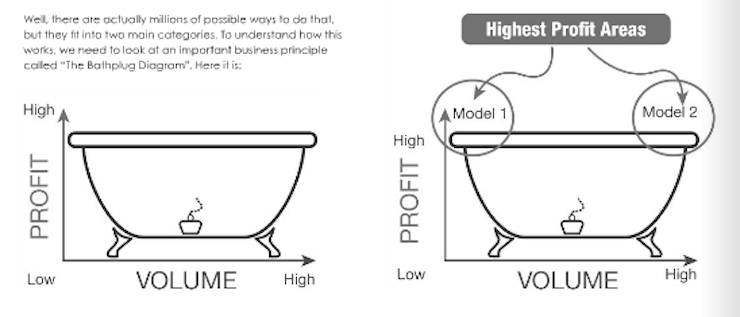
Well, there are actually millions of possible ways to do that, but they fit into two main categories. To understand how this works, we need to look at an important business principle called “The Bathplug Diagram”. Here it is:
Imagine that you’re looking at the cross section of a bathtub, with the plughole at the bottom. Every business lies somewhere on the curved line. Here’s how it works:
The people who make the highest profit are those at the top left and the top right of the diagram. Those at the top left are the ones who do a small volume of business, but at a very high price with a large profit margin. Like, say, a designer clothes store. Those at the top right of the diagram do a large volume, with low prices and a small profit margin. Like Kmart or Target.
The problem for most people is that they are too afraid to claim either of these two extreme positions. Instead they try to be “everything to everyone”, taking all business that comes along, and charging the least amount they can without going broke.
It’s these people in the middle who struggle. The reason for this is that, when the economy goes bad, or if “the plug is pulled” on the economy, these are the first ones to go down the drain.
So here’s the key: the further up the sides of the bathtub you are, the better you’ll perform. You can achieve this position in one of two ways:
Model one: low volume, high price (like a designer clothes store)
This is probably the easiest model to set up. The way you do it is by finding a niche that you can specialise in. There are thousands, if not millions of possible niches out there. The reason that specialising works is that, given the choice, people would rather be trained by a specialist who knows exactly what they need, rather than a generalist who takes all-comers. And people are prepared to pay more for that refined expertise. “Find a niche that you can specialise in.”
Model two: high volume, low price (like Kmart or Target)
This model is generally a bit more effort to set up. The way you do it is by finding ways to have a lot more clients without having to spend a lot more hours on the job. That means leveraging your time. Here are two ways you can do that:
- Have some type of membership based group model. Instead of seeing one person and charging $200 an hour (like the specialist), you could see ten people and charge them each $20 per hour to get the same outcome.
- Hire a lot of trainers to work for you. In this case you teach a lot of other trainers your system, and take a percentage of every dollar they earn. It does mean hiring and managing staff (which requires a streamlined system to be in place), but it can be very lucrative in the long term.
How to become a specialist in the fitness industry
Specialising allows you to do a number of things:
- You can target your marketing, so you need to do less marketing and you get more clients.
- You can charge more, as people expect to pay more for a specialist, and they’re not just comparing you on price.
- You can work less hours without a cut in income, since your hourly rate goes up.
- You keep your clients for longer, since your training is tailored exactly to suit them.
So exactly what do I mean by “finding a niche to specialise in?” A more accurate description would be “finding a niche within a niche to specialise in”. In other words, you’re after a fairly narrowly targeted group. When I talk to personal trainers about specialising, they’ll often say to me something like “Oh, I already do that. I specialise in working with women.”
Well, this is actually not what I mean when I talk about “specialising” because “women” is a very broad niche; in fact, it’s roughly half the people in the entire world!
Instead, you need to find a niche within this broader niche.
Here are some examples of niches within the niche of “women”: overweight women preparing for pregnancy, brides-to-be who want to look their best on their wedding day, or new mums who want to get back in shape after having a baby.
Avoid the rookie mistake that many Personal Trainers make. In their first attempt, many people who try to define a niche for themselves tend to choose one that is either too broad or too narrow. The next section will help you avoid falling into this trap. There literally are thousands of “niches within niches” out there, so how do you choose the right one for you? There are a few criteria that a good niche must meet.
Choosing a specialised niche as a PT
Let’s look at an example and how it stacks up against the five criteria: let’s look at the niche “brides-to-be who want to look their best on their wedding day”.
Criteria 1: There must be a big enough group of people in that niche.
On average in Australia every year there are about six marriages for every 1,000 people. So if you live in a city with a population of one million, then there will be about 6,000 potential new clients. Given that you’re probably looking for only 50 to 100 clients a year, this is plenty.
Criteria 2: People in the niche must be hungry for your service – they must really want it.
There are not too many brides-to-be out there thinking “nah, don’t think I’ll bother doing anything special for my wedding day. I’ll just rock up as I am really.” Whether it’s losing weight, or just toning up, you can guarantee most brides-to-be have at least thought about a physical tune-up prior to their big day.
Criteria 3: Do you already have a track record in this niche?
Have you trained brides-to-be before? Are you able to get them to sing your praises in a testimonial? One thing that’s great about this niche is that it’s really easy to get great testimonials to use in your marketing. “Before and after” pictures are a very powerful persuader.
So you can imagine the contrast between the picture of the overweight bride-to-be, and the gorgeous, glowing bride on her wedding day. Envy and desire are hugely powerful motivators!
Criteria 4: Is it easy to find people in your chosen niche?
Are brides-to-be easy to find? They buy bridal magazines, buy wedding gowns, choose wedding cakes, book reception venues, set up gift registries, choose wedding flowers, go to bridal expos – the list is endless.
Criteria 5: The people in the niche are willing and able to pay for your services.
The average cost for a wedding in Australia is currently $50,000! Brides-to-be expect to outlay large sums of money for everything on “the best day of their lives”, so you can bet most will be willing to pay more than average for the right personal trainer to have them looking their very best on their wedding day.
Your action task from here is to start brainstorming some possible niches and apply the five criteria directly to them. Remember that you need all five to stack up from a business perspective. When you find one that works and you are truly passionate about it, give it a go!
Check out these articles:

Opening a Gym in Australia: Is the Market Saturated in 2026?
The Australian fitness landscape has transformed dramatically over the past decade. Between 2015 and 2024, the number of gyms and fitness centres across the country expanded at an unprecedented rate, driven by boutique studios, 24-hour franchises, and increasingly health-conscious consumers. Now, as we move through 2026, aspiring fitness entrepreneurs face a critical question: has the

Legal Steps to Prepare Your PT Business for the New Year
The end of the year brings more than just Christmas parties and beach holidays for Australian personal trainers. It’s the perfect opportunity to ensure your legal house is in order before the new year begins. While most PTs are brilliant at designing programs and motivating clients, the legal side of running a personal training business

6 Selling Tips To Make Your Fitness Business Boom in 2026
The Australian fitness industry is experiencing a profound transformation. After weathering pandemic closures, navigating the hybrid training revolution, and watching consumer behaviour shift dramatically, fitness professionals across Sydney, Melbourne, Brisbane, and beyond are entering 2026 with a critical question: how do we not just survive, but genuinely thrive? The businesses that will boom in 2026

Personal Training Clients on Weight Loss Medication
As more Australians embark on medical weight loss treatments, many trainers now find themselves training clients on weight loss medication without fully understanding what these drugs do, how they affect exercise performance, or what’s within their professional scope. Clients may casually mention, “I’ve just started Ozempic,” leaving trainers torn between curiosity, concern and confusion. In

A Guide to Understanding Music Licensing For Fitness Businesses
The soundtrack of a fitness business does more than fill silence. It sets pace in a HIIT block, softens the edges of a busy floor, and helps a new member feel like they belong. It is also, in Australia, a legal and operational choice. If you play commercially available music in a business, you are

The Plus Fitness Playbook To Successful Scaling
The opening of Plus Fitness Mambourin last month marked a milestone for the brand, which has seen its trajectory turbo-charge since its 2020 acquisition by ASX-listed company Viva Leisure. Mambourin marks 200 clubs opened with around 200,000 members and more sites in the pipeline across Victoria and New South Wales. For Australian gym owners, a

Merchandising for Gyms: A Smart Strategy for Member Retention in 2025
A few years ago, it wasn’t the norm for gyms to sell things like protein powders and branded t-shirts. Today, gyms are more than just gyms — they’re brands. If you’ve created a community at your gym that makes people feel like they belong, the place where they train becomes a part of their identity.

Take Advantage Of 2025 EOFY Sale On Commercial Gym & Fitness Equipment
With June 30 fast approaching, fitness business owners across Australia are preparing to wrap up the financial year, which means it’s the perfect time to upgrade your gym setup. There are numerous reputable suppliers with a sale on commercial gym and fitness equipment. Smart investments now could be fully tax-deductible, giving your business a financial

3 Fitness Products You Should Have In Your Gym in 2025
The Aussie thirst for gym facilities is as strong as ever and the greatest challenge for fitness business owners is retaining members in a highly competitive market. There are some pieces of equipment that you could expect to find in pretty much any fitness centre, such as weight plates, dumbbells and cardio machines, but what